Rural cancer inequity in Australia: how the ECORRA Trial is closing the gap
Rural Australians with cancer have 15% lower odds of survival than their urban counterparts. The ECORRA Trial team, winners of the inaugural Lancet-Elsevier Foundation Evidence to Impact Award, explain how they are working with rural health services and consumers to change that.
This article was drafted by Dr Charlene Wright, on behalf of the ECORRA Trial team
Approximately seven million Australians live outside major cities, and geographic location remains an independent determinant of cancer outcomes. Our recent meta-analysis found that people with cancer living in rural areas have 15% lower odds of survival than their urban counterparts, after adjusting for clinical, demographic and socioeconomic factors. Delayed diagnosis and treatment are key contributors, with rural patients waiting up to 53 days longer for diagnosis and treatment commencement.
Rural cancer inequity in Australia: what the evidence shows
The ECORRA Trial was established to address this inequity. Led by Professor Anna Ugalde at Deakin University and funded by the Medical Research Future Fund (2024 to 2029), it takes a three-phase approach, grounded in implementation science, to translate evidence into practice:
- Discovery Phase: understand how cancer care is delivered across rural and remote health services.
- Co-design Phase: develop an evidence-informed, sustainable and scalable implementation package.
- Implementation Phase: embed and evaluate the package.
Establishing the evidence base
A fundamental barrier to evidence synthesis in this field has been inconsistent measurement of rurality. Across 289 studies from 22 OECD countries, we identified 27 different rurality classification systems, which has historically precluded meta-analysis. We developed the Rural-Urban Classification System Harmonisation Framework, aligning 11 systems with the OECD Extended Typology to create a standardised five-point rurality scale.
These papers form part of a five-paper series in The Lancet Regional Health – Western Pacific. The series also examines strategies for implementing evidence-based cancer care in rural settings, the historical evolution of Australian cancer policy and its impact on equity, and recommendations for achieving equitable cancer outcomes for rural and remote communities.
Discovery Phase: identifying what gets in the way
Australia’s national cancer care guidelines, the Optimal Care Pathways, outline best-practice processes and timeframes for diagnosis and treatment across more than 30 cancer types. To address the needs of rural communities, the broader ECORRA program led the development of the first Optimal Care Pathway for people living in rural and remote areas with cancer, published in 2026. However, how these pathways are put into practice in rural health services has been poorly understood.
We conducted a sequential mixed-methods study, guided by the Theoretical Domains Framework, with 74 health professionals working across rural health services in Victoria, South Australia and Queensland.
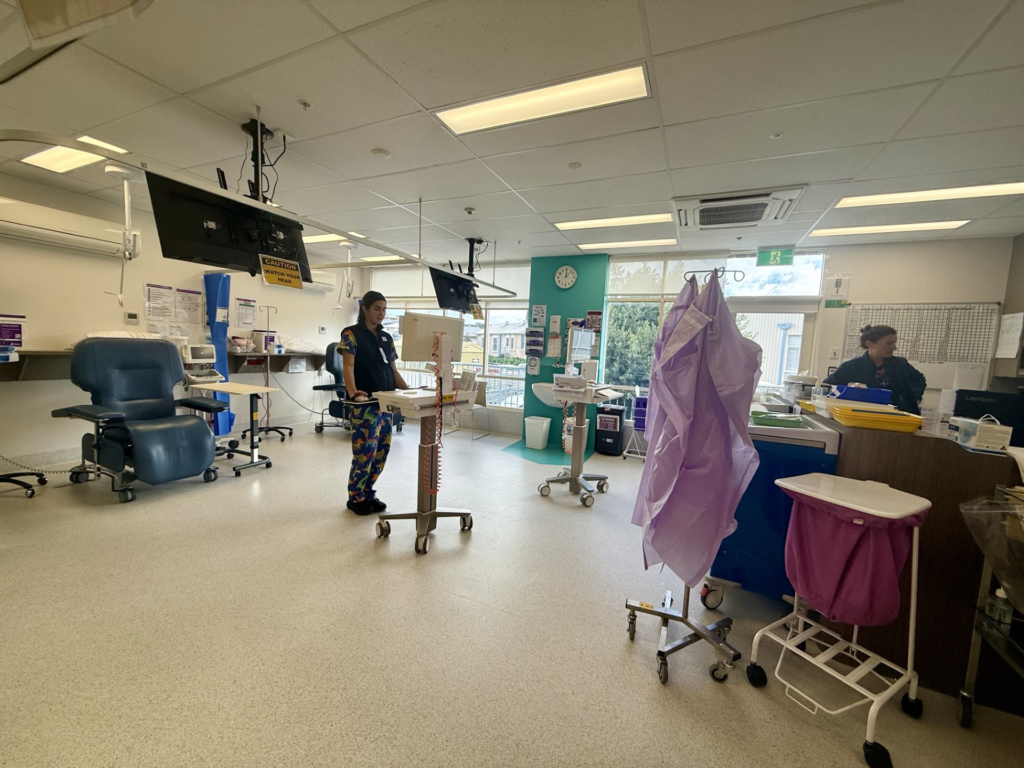
Most participants agreed that pathway-aligned care is worthwhile, yet fewer than half were confident their teams could consistently meet recommended timeframes. Rural services showed considerable adaptive strengths, including tele-oncology, hub-and-spoke models, rapid-access diagnostic clinics, outreach specialist services and dedicated care coordination roles. However, timely care frequently relied on individual clinician vigilance, informal professional networks and locally developed workarounds where formal systems were fragmented or absent.
These findings indicate that equitable implementation requires strengthening the systems that support rural clinicians, including referral and information connectivity, resourced care coordination and routine pathway monitoring, rather than relying on individual effort to make up for system limitations.
Co-design Phase and consumer partnership
Consumer partnership is embedded throughout ECORRA’s governance and research processes. A 14-member National Consumer Program contributes to decision-making across the project, alongside rural health services and clinicians.
In the Discovery Phase, consumer partners with lived experience of cancer in rural areas reviewed and refined the survey and interview instruments before data collection. Consumer investigators contributed to the interpretation of findings and the selection of illustrative quotations, strengthening the credibility and relevance of the analysis.
Consumer input has also shaped how the research is framed. Representatives emphasised that their identity should be recognised primarily as people living in rural and remote areas, where they experience substantial social, environmental and lifestyle benefits, and secondarily as people with lived experience of cancer. This has shaped a strengths-based approach across the research program.
Implementation Phase: evaluation and scale-up
Drawing on these findings, ECORRA is co-designing a multi-component implementation package with rural health services and more than 80 collaborators nationally. The package will be evaluated in a pragmatic stepped-wedge cluster randomised trial across 14 rural and remote health services. Co-design with the services responsible for delivery is intended to support sustainability and inform national scale-up.

Looking ahead
Australians in rural and remote areas are now recognised as a priority population in the Australian Cancer Plan. ECORRA aims to generate the evidence needed to turn this policy commitment into measurable improvements in timely, equitable cancer care.
The team is honoured that the ECORRA Trial was recognised in the inaugural Lancet-Elsevier Foundation Evidence to Impact Awards, and acknowledges the investigators, partner health services, consumer partners and rural communities whose contributions make this work possible.
Hear from the winning teams
Join The Lancet and the Elsevier Foundation on 18 November 2026, 9:00 to 10:30 GMT, when the three winning teams of the inaugural Evidence to Impact Awards share their work.
