Envisioning Futures report: amplifying women’s voices and leadership in Japanese science
What does it take to transform a nation’s scientific landscape? Sometimes, it’s the courage of a few extraordinary individuals – and the collaboration of forward-thinking institutions – to light the way for many. With the launch of the “Envisioning Futures: Women’s Leadership and Gender Equity in Japanese Research” report, the Elsevier Foundation and RIKEN are shining a spotlight on the journeys, achievements and challenges of women research leaders in Japan.
A shared responsibility for change
For years, Japan has stood at the forefront of global innovation. Yet, beneath the surface, a persistent gender gap has limited the full participation and advancement of women in research, especially at senior levels. As of March 2024, women make up just 18.5% of Japan’s research workforce, significantly below the global average. Even more striking: only 16% of authorships on scientific publications and 17% of patent applications come from women in Japan.
Numbers like these paint part of the picture, but what’s often missing are the voices and stories behind them. That’s why Envisioning Futures takes a dual approach: weaving together robust national data with candid interviews from nine accomplished women principal investigators and research leaders. Their stories offer insights that are both deeply personal and universally relevant.

Journeys that inspire
One of the most compelling takeaways from these interviews is that there’s no one “right” path to success. Many women leaders described nonlinear career journeys, shaped by unexpected opportunities, family responsibilities and career interruptions. Instead of viewing these as setbacks, they reframed them as sources of resilience and perspective. Flexibility, adaptability and the ability to seize opportunities emerged as essential traits.
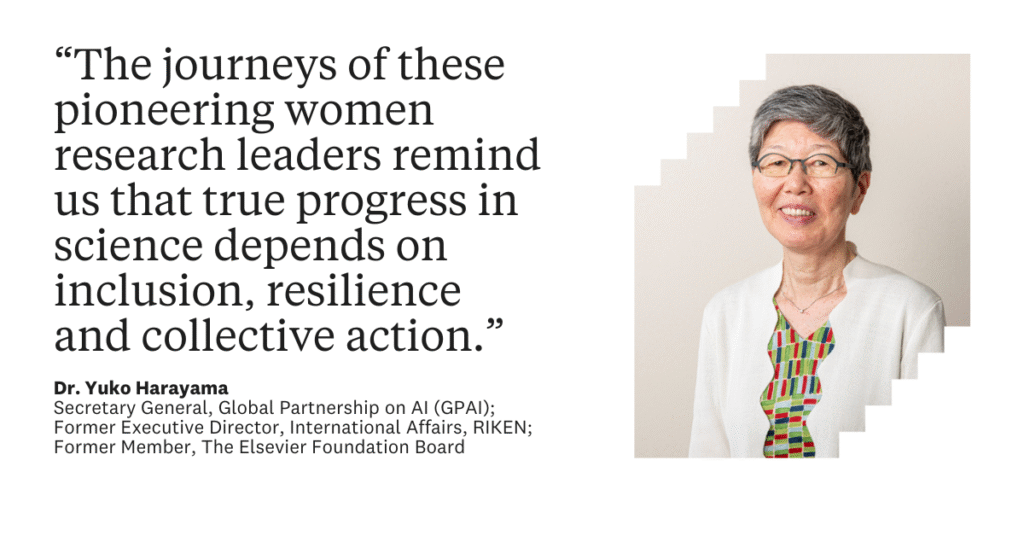
As Dr. Yuko Harayama, one of the report’s key contributors, puts it:
Opportunities come along in many shapes and forms, and it all comes down to whether or not you seize them.
Building inclusive lab cultures
Leadership in science isn’t just about technical expertise – it’s about people. The researchers profiled in Envisioning Futures spoke about the importance of fostering lab environments where everyone feels they belong. Rather than traditional hierarchies, they championed open communication, collaboration and psychological safety. Informal mentoring and respect for diverse working styles were common themes, as was the belief that real innovation springs from teams with a variety of backgrounds and perspectives.
Dr. Naoko Imamoto shared her vision:
I want my lab to be a place where everyone feels like they belong.
Mentorship: the power of networks
Mentorship and professional networks came up again and again as catalysts for advancement. Many interviewees credited their mentors for giving them the technical guidance, encouragement and confidence to pursue their ambitions. These relationships often extended beyond professional advice, providing vital emotional support during challenging times. The lesson? No one succeeds alone, and building strong, diverse networks is key for anyone embarking on a research career.
Barriers that still stand
Despite their successes, these women have confronted formidable cultural and structural barriers. Unconscious bias, unequal evaluation and limited access to family-friendly policies continue to slow progress. Some described being hired at lower ranks than male counterparts with similar qualifications, or being overlooked for opportunities due to outdated assumptions about women’s ambitions or family commitments.
Change is happening, but it’s gradual. Japanese government policies now set ambitious targets for women’s participation in research and leadership. However, progress remains slow, especially in STEM fields and at senior levels. The report calls for coordinated, systemic action – from institutions, policymakers and individuals alike – to dismantle these barriers for good.
Redefining success in science
One of the most exciting aspects of Envisioning Futures is its challenge to the traditional definitions of “success” in academia. The report argues for a broader view of excellence – one that recognizes mentorship, interdisciplinary work, societal impact and science communication alongside the usual publication and patent metrics. It’s a vision that values the full range of contributions that make science stronger and more relevant to society.
A roadmap for the future
The report doesn’t just highlight problems; it offers practical recommendations for moving forward. Institutions are urged to embed gender equity in their strategies, implement transparent and bias-free processes and support flexible career paths. Policymakers are called to set ambitious targets, introduce targeted funding, and modernize evaluation frameworks. And for aspiring women scientists, the message is clear: seek out mentors, embrace nonlinear paths, and never underestimate the value of your unique journey.
Dr. Motoko Kotani, Executive Vice President for International Research Strategy at Tohoku University and Executive Director of Science at RIKEN, sums it up: “The journeys of these pioneering women research leaders remind us that true progress in science depends on inclusion, resilience, and collective action. By embracing diverse career paths and recognizing a broader range of achievements, we can build a research ecosystem where all voices are heard and innovation flourishes.”
We invite you to read the full report, share these stories and join in building a more inclusive, innovative and equitable future for science in Japan – and around the world.